

Review: Apple IPhone 5S — This Is the Most Exceptional Yet Boring Yet Brilliant IPhone.
 | Cam Lincoln
 Screen: 4.0-inches, 640 x 1136 px, 1,670,000 colors, IPS (Retina Display / Gorilla Glass / Gyroscope / Accelerometer / Proximity Sensor / Ambient Light Sensor)
Camera: 8.0 MP / Intelligent LED Flash / Burst Mode / Auto-Focus / Touch Focus / Panorama / Face Detection / 1080p Video Recorder / 1.2 MP / FaceTime Video Chat / Slow-Motion Recording
Processor: 1.5 GHz (Apple A7)
Data: LTE / cdma2000 1xEV-DO Rev. A / HSPA-Plus
Memory: 16.0 GB or 32.0 GB or 64.0 GB
Slot: No
Form: Block / Apple iPhone OS 7.0
Dimensions: 124 x 59 x 8 mm
Weight: 112 g
Battery: Li-Ion
Talk Time: 10 hours
Standby Time: 10.4 days
If all smartphones were as attractive as those made by Apple, I would be a happy man. There the iPhone 5S is, a sleek and elegant brushed aluminum body, nestled between two protective sheets of plastic, fitted within a clean, iconic box. Its style is distinctive, its colors are — wait… different?
In the iPhone family, colors came in two flavors: white and black. But now you can add gold to the mix. Well, technically, silver with white glass accents, a darker anodized aluminum gray with black, and classy champagne gold with white.
Besides those variations, there’s little to distinguish the 5S from the iPhone 5, but that’s not a bad thing — the 5 was a stunning feat of engineering and design, which contoured comfortably in the palm of the hand and fit perfectly into any purse or pocket.
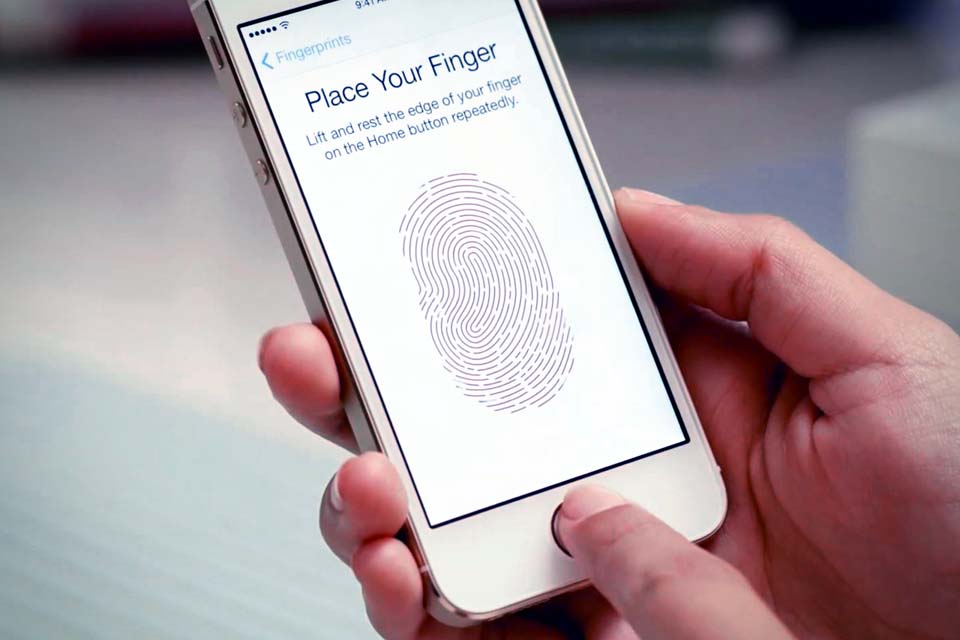
Look closely, and you’ll see a subtle metal ring around the Home button, hinting at the magic behind the 5S. One press the button awakens the iPhone, but hold your finger there for about a half-second and it’ll unlock the device, all without entering a passcode.
I gently place my finger on the slightly-concave button, and the invisible reader quickly scans beneath the outside layer of the skin for a match. Even when I hurriedly placed a finger off-kilter or in odd angles and positions, it worked all the time, every time.
You can also use a fingerprint to buy books, music, apps and videos from Apple’s App, iTunes and e-book stores.
This is not the bulky swipe-down readers of the past; it is a big leap in in biometric technology. Simple and reliable, it never failed me once. But if it does, it’ll prompt you for a tried-and-true passcode.
But why would you?
Apple says the odds someone else’s finger working are 1-in-50,000, compared to the 1-in-10,000 to break a four-digit passcode. Frankly, it’s a far more convenient and secure way to access an iPhone — a win-win.
The 5S can save up to five fingerprints, encrypted and stored as mathematical algorithms, and not images, on a walled-off section of the A7 processor. That means it’s secured away from prying third-party apps, servers or cloud services, and neither transmitted nor stored online.
How’s that for security?
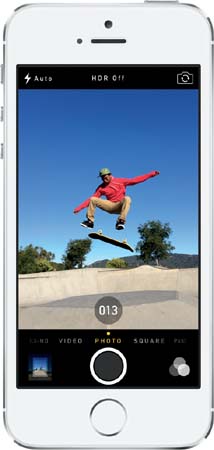
Apple also made big improvements to the 8-megapixel camera. On paper, it resembles the iPhone 5, but the lens of the 5S is now increased to f/2.2, and the pixels of the sensor capture 15 percent more light and color data. In fact, compared to the iPhone 5, the 5S consistently captured sharper and more vibrant photos, especially noticeable in low-light, whether in dangerous, dark-lit alleys no man in good conscious to walk down, or a dim candlelight dinner no woman would pass up.
That’s because every time you takes a picture, the 5S actually snaps four photos in quick succession, and then combines the sharpest and most accurate colors from each part into one superior result. Close-up shots display an extraordinary amount of detail, with a shallower depth-of-field for a more professional feel.
That also means places that would usually need a flash, no longer do. But if you want to, the size of the LED flash is doubled, with not one, but two LEDs — one that’s pure white and another in warm amber. According to Apple, the intelligent flashes mix to produce one of over 1,000 variations of light colors, used to match the lighting of the room for warmer, more natural tones, and less washed-out faces. It really works, and the results are obviously clear.
For action shots, hold down the shutter to activate Burst Mode, which keeps shooting at 10 stills a second. The series of pictures is then cleverly bundled in a folder, with the best of the bunch — auto-picked based on clarity and exposure, among other factors — labeled with a dot, making it simple to pick a favorite and delete the rest.
The software also comes with fun, Instagram-style filters. Although I still prefer the lens of the Lumia 1020, I have to admit that the camera system on the 5S is very, very good.
Drag a finger to switch to video recording. With 3x digital zoom and improved image stabilization, you can record better-looking 1080p clips. But best of all, a slow-motion function captures 720p video at 120 frames per second, and then stretches it out to playback at 30 frames per second. The quality is outstanding and it’s sinfully fun to use, turning a simple walk down the hall into a tension-filled saunter, or a sprint down a football field into a suspenseful action sequence.
One gripe: sometimes the audio gets stretched a bit too far to fit the video, resulting in an oddly eerie quality. A 1.2-megapixel front-facing lens is brighter and more detailed, as well, for improved FaceTime chats and selfies for Facebook.

The backbone of any phone is the processor. The iPhone 5 was twice as fast as the 4S, and following Moore’s Law, the 5S is now twice as fast as the 5. That great, of course, except I didn’t really notice a huge jump in speed — boot times weren’t significantly faster, and games and apps ran as smoothly as on the iPhone 5.
Apple says the types of games to take advantage of its more graphics-rich A7 processor haven’t yet been released — but they’re coming. Using 64-bit computing, the 5S can process larger chunks of data at faster rates, so games with an extraordinary amount of fine detail, like Infinity Blade 3, render just as fast, without hiccups or stalling during the sword-slicing gameplay.
But more interestingly, a separate M7 processor collects every gesture and motion from the accelerometer, gyroscope and compass. Why a separate chip? Because the A7 processor requires an extraordinary amount of power — six times more power than the M7. That means, not only does the 5S always monitor data, but it also has a longer battery life by allowing the A7 chip to remain asleep.
The M7 chip might give a glimpse of a future of health-tracking and motion-aware apps to come, as well. An iWatch, perhaps? Regardless, with two processors, the 5S has the best of both worlds — faster performance and a longer battery life.
Apple redesigned IOS 7 to look completely different from previous versions of the software, and you’ll either love or hate the clean and streamlined interface, the sharper, more delicate fonts and the brighter hue of colors. It’s less distracting, so it’s easier to navigate, and easier to find items.
Every tap, swipe and gesture feels incredibly snappy. And the flatter, simpler icons are redesigned to look as if they’re hovering above the home screen. Buttons and controls are lighter and thinner, too, and in the browser, they shrink and disappear to make room for content. All of the effects seem to try to give the illusion of a bigger 4-inch Retina display.
The iOS 7 overhaul is the biggest yet, with improvements in multitasking, notifications, controls, e-mail and Web browsing. Apps also have a clearer layout and ringtones and alerts have better sounds — even Siri is smarter and turns on Bluetooth or play videos.
Swipe down from the top to see an overview of the day, including weather and schedule. Pull up from the bottom to view the control panel and quickly toggle Wi-Fi, Bluetooth, music, brightness and even the flashlight function. Activate AirDrop to create a local area and share documents with a specific person, a group of contacts or even outright strangers.
Apple offers a free streaming-radio service through iTunes, similar to Pandora, while new device owners receive a free bundle of apps — including Pages, Numbers, Keynote, iMove and iPhoto — to match the suite that rivals are offering.
As you’d expect, iOS 7 runs smoothly on the 5S. I love the bigger layout in Safari, but the interface and menus are often confusing. Like any change, I resisted at first, but eventually I got used to it.
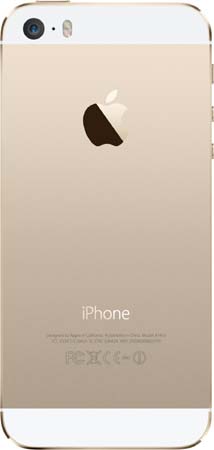
The 4-inch Retina display is the same size as the iPhone 5, which is to say, a bit small compared to rival Android flagships. But it fits nicely into a hand or pocket, and provides more than enough of a canvas to comfortably watch movies and play games.
Sound quality is exceptional. The music I blasted from the speaker, located on the bottom, was loud enough to fill a typical room.
With heavy use — defined as watching movies, streaming music, taking photos and the plethora of things I use every day — the 5S lasted around a quarter longer than the iPhone 5 — a little over a day. With moderate use, I squeezed out nearly two days on a single charge.
If you already own the iPhone 5, consider whether you really need the 5S — because frankly, there’s not much new, aside from a nifty fingerprint reader and a better camera, and IOS 7 is available free for download on iPhones.
Unless you own a 4S or earlier, I find little reason to splurge on a 5S — even if it is one of the best devices you can buy. Otherwise, take a look at its cheaper, more colorful, sibling: the iPhone 5C.
Other Reviews From Around the Web:
- New York Times
- Wired
- AllThingsD
- Time
- The Telegraph
- USA Today
- ABC News
- CNET
- Engadget
- TechCrunch